

 Skip to content
Share this post

Alex was born in Barcelona, Spain. After several years working as a middle school teacher, he decided to pursue a new challenge and completed the intensive online full-time CELTA course with Oxford TEFL in January 2025. Shortly after earning his qualification, he began his English teaching career at a language school in a rural region of northern Japan, where he now helps students develop their confidence and communication skills in English.
In this blog post, find out how he went from an aspiring English teacher to moving to Japan and teaching English.

Can you introduce yourself and tell us where you’re currently living and working in Japan?
My name is Alex and I am from Barcelona, Spain. In my late twenties, I decided to immigrate to Japan, moving to Tokyo in July 2025. I am currently living in the Yamagata prefecture, which is in the northern part of the main island of Japan.
In this relatively rural area, I work as an English teacher for the English school (eikaiwa) “MY English School”. The word eikaiwa literally means “English conversation”, which gives a good idea of one of the main focuses of the curriculum.
What were you doing before taking the CELTA, and what made you decide to become an English teacher?
I come from a family of educators: both of my parents, my grandmother and a number of relatives have or had careers in education, so it was only natural I would follow suit. After obtaining a university degree, I studied a Master’s in teaching and started working as a substitute teacher in the Spanish public education system.
Although my degree’s subspecialty was not English but music, I was allowed to teach it thanks to a strong English credential. In one of those classes, I felt like while I could teach, I was not comfortable with the material. I had a lingering feeling of missing something, so I decided to take the CELTA in an attempt to close that gap. In a way, it didn’t help me become a teacher per se, but rather helped me understand how English is taught and gave me tools to teach languages in general and English in particular.
Additionally, when I signed up for the CELTA, I was already planning my move to Japan, so I figured it would be a two for one: I would be more comfortable in the classroom at that moment and it would be a nice bonus for my CV. Little did I know how useful it would become.
Why did you choose to take your CELTA with Oxford TEFL?
Not being an English native speaker, I had taken Cambridge certification exams before, so I knew that amongst all the TEFL qualifications, CELTA was the one I wanted. Reputation-wise, it was a no-brainer too: Cambridge certifications were very prevalent in the requirement sections for a lot of job offers I could find in a number of job hunting websites.
Having decided that, while I was investigating who to take the CELTA with, I saw that OxfordTEFL was in Barcelona and it was not far from where I lived, so going in person and asking about the course was a pretty easy thing to do. After talking to the staff in person, I was convinced that studying with them was the right choice. The program is set by Cambridge, sure, but the way OxfordTEFL approached it convinced me – and did they deliver!
What was the most valuable thing you learned during the CELTA course?
To me, this is a rather straightforward question. In one word: reasons. There is no right or wrong way to teach, only results: did the student learn what you, as a teacher, wanted them to learn, or did they not? A number of variables go into the equation when making a lesson plan, when delivering a lesson, when building a curriculum, etc. Thus, I left the course convinced that what’s important is not what is done but rather why.
For example, the same activity may or may not work with different groups of the same age because of the number of students, their personalities, the difference in language skills or a myriad of possible causes. So it is on the teacher to anticipate, decide and adapt to ensure the learning really occurs.
Was there a particular moment during the course when you felt your confidence as a teacher grow?
Yes, I did. After the fourth teaching practice, I had a feeling it went well and, at first, I thought that it was due to me doing the course online and having gotten a good handle on the software. While that may have been part of it, a classmate noted that the way I delivered the lesson was “like a teacher”, and our tutor commended that lesson in particular, so I think that was a turning point for me.
In hindsight, I think it was not about the software or the content, but rather about confidence and trusting myself. I try to hold myself to very high standards, which is great for some things, but has the unfortunate side effect of never trusting what I do to be well done, so that was definitely a significant moment.
How soon after completing the CELTA did you find your first teaching job, and what was that process like?
I did not use the CELTA to actively look for work until a few months after moving to Japan, so that would be about a year after completing the course: five months still in Spain and eight months of Japanese school.
I do not think I did anything special, though: I registered on job-hunting platforms and applied for jobs I thought I would be a good fit for, interviewed with the companies that got back to me and accepted the offer my current employer made. It took about two months to get a positive response, which is a reasonably short time by “jobseeker in Japan” standards.
While it’s true I did not end up working for one of OxfordTEFL’s partner schools, the career service helped me tune my CV and their database was a great starting point.
What attracted you to teaching in Japan, and how did you make the move happen?
What I like most about Japan is that it is a very organized society, which is simply a better fit for my personality and way of thinking. While my native Spain was amazing in some ways, I was not convinced about teaching long term there, seeing how the substitutions I was doing for the public system were going. This is not to say that Japan is devoid of issues, by any means, but as far as I can tell, schools in Japan seem to match my beliefs about education, and that shared vision makes me more motivated to work well.
As for the move, there are not that many ways to move to Japan. Foreigners either go on a work visa, meaning a Japanese company offers them a job, on a spouse visa, which is self-explanatory, or on a student visa, for whichever education institution it may be. My case was the latter: I did the application process and all the bureaucratic requirements throughout the course of the 2024-25 school year and moved to Tokyo to enroll in a Japanese school. I wanted to learn the language first, then look for work.
Can you describe a typical day in your current role and the types of students you teach?
I currently work from Tuesdays to Saturdays. On weekdays, I have an afternoon-evening schedule, so I get to the school about ninety minutes before my first lesson to prepare for class. During that time, I review my lesson plans, sort the materials I will need for each group and prepare the classroom. After that, it’s “just” delivering the lessons and cleaning up.
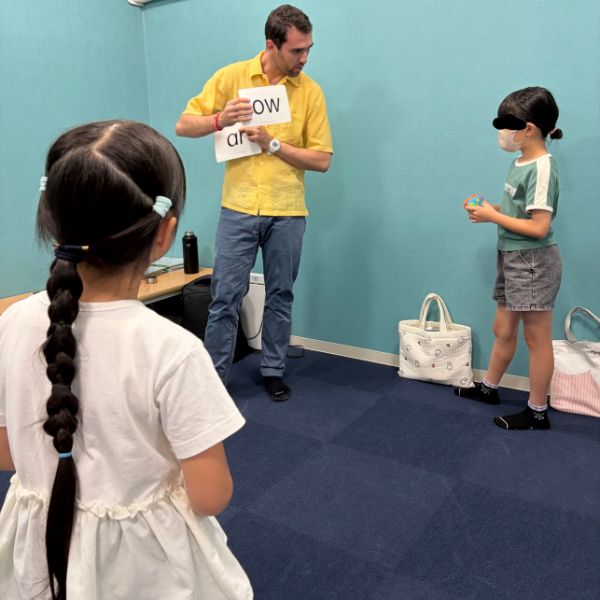
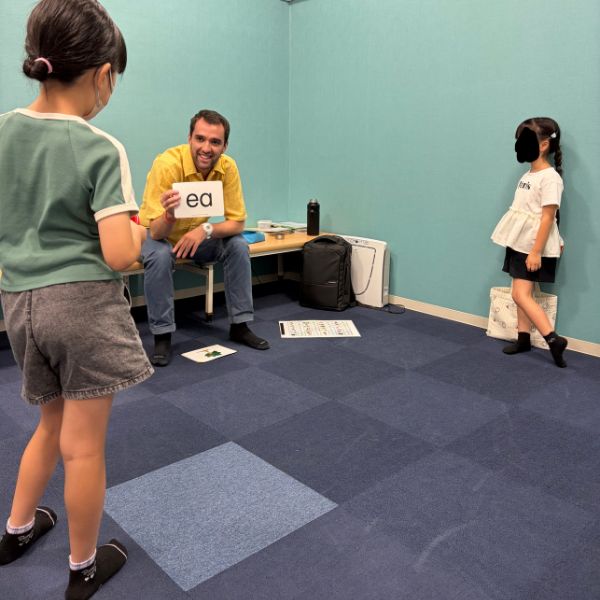
I have an earlier start on Saturdays, seeing as schools are closed and our plaza is open all day, but what I do doesn’t change all that much. I also go on dispatch to nurseries to do some activities in English with little kids, but the main focus is on the English school.
Being an “eikaiwa”, most of the students I work with are either in Elementary School or Junior High School. However, I have some kindergarten classes and some older students (High Schoolers and adults) as well. You could say that, while younger ages are most prevalent, I do teach all ages, with the positives and negatives that come with each.
In what ways has the CELTA helped you succeed in your teaching career in Japan?
The CELTA has benefited me in two major ways while I have been in Japan. While I was enrolled in a Japanese academy, I got to teach private lessons on an online platform. Being able to prove I had the CELTA allowed me to add a “professional” badge on my profile, making it stand out more and potentially attracting new students.
Additionally, my current employer puts an emphasis on teaching credentials and wants all of their teachers to have one of said certifications. The CELTA is one of the courses they approve of, and many teachers have had to take it (or an equivalent) while working. Having it already in hand, I didn’t need to, which resulted in an easier landing on the job.
What have been the biggest challenges and rewards of living and working abroad?
The language barrier is a pretty common difficulty for any immigrant, but in the case of Japan, there are big cultural differences that can prove challenging as well. Building a social circle can also be quite complicated, whether due to one’s Japanese skills or because of the aforementioned cultural differences. Also, there is a lot of bureaucracy here, and while effective, navigating it is complicated.
There are positives too, of course. The language learning process, understanding more and more about what’s going on, and gradually being able to handle more situations is quite a rewarding feeling. Every small success feels somewhat more grand too, probably because of those extra challenges that had to be overcome to achieve.
Looking back, how has taking the CELTA changed your career opportunities and professional development?
I definitely think it opened doors for me. Like I mentioned, I used to teach mainly music, so acquiring the skills to teach something as universal as English was a game changer. I now can apply for an English teaching position with confidence that I was not out of place.
Something I’ll mention specifically is that the CELTA is one of the most widely recognized TEFL certifications, and many people I have talked to in Japan agree with that. So while having a Master’s is great and all, I am convinced that the CELTA was the difference maker.
What advice would you give to someone who is considering taking a CELTA with Oxford TEFL and teaching English internationally?
I would strongly suggest having a plan coming into the course; or, at least, an idea of what you want to do after completing it. There is definitely work as an English teacher, in many ways, but you cannot expect it to magically come to you. The CELTA will give you the keys to the car, but you are still the driver and the road is not necessarily going to be easy.
Where do you see yourself in the next five years, and what are your future goals in ELT?
Wanting to stay in Japan long term, my main priority besides teaching is studying Japanese properly. Having learnt English to the point where I teach the language for a living, I know exactly where I stand in terms of ability, and it’s going to take a while.
Once I’m through, however, I will see what the options are. My current job is great, so staying here is absolutely a strong option. Teaching high school or college classes is in the back of my mind, even if I’m not actively thinking about it. It would be going back to what I was doing in Barcelona, and personally I think that teaching higher levels is more interesting than teaching lower levels. Online lessons are also a possibility, though that would entail visa challenges.
I really, truly, don’t know where I’ll end up at this point, but I do know that ELT was the key to accessing Japan, the Japanese job market and to my current life. For that, I’m very grateful.
Would you like to gain an internationally recognised qualification to teach English as a foreign language anywhere in the world? The Cambridge CELTA is your fist step into a rewarding career as an English teacher and is requested by around 75% of employers worldwide.
We offer:
4-week 100% Online CELTA courses
14-week 100% Online CELTA courses
4-week face to face CELTA courses (in Barcelona)
Get in touch with us at [email protected] to find our more or apply via the course page above.


Oxford TEFL
Typically replies within minutes
Hello, how can we help you?
WhatsApp Us
🟢 Online | Privacy policy
How can we help you?